
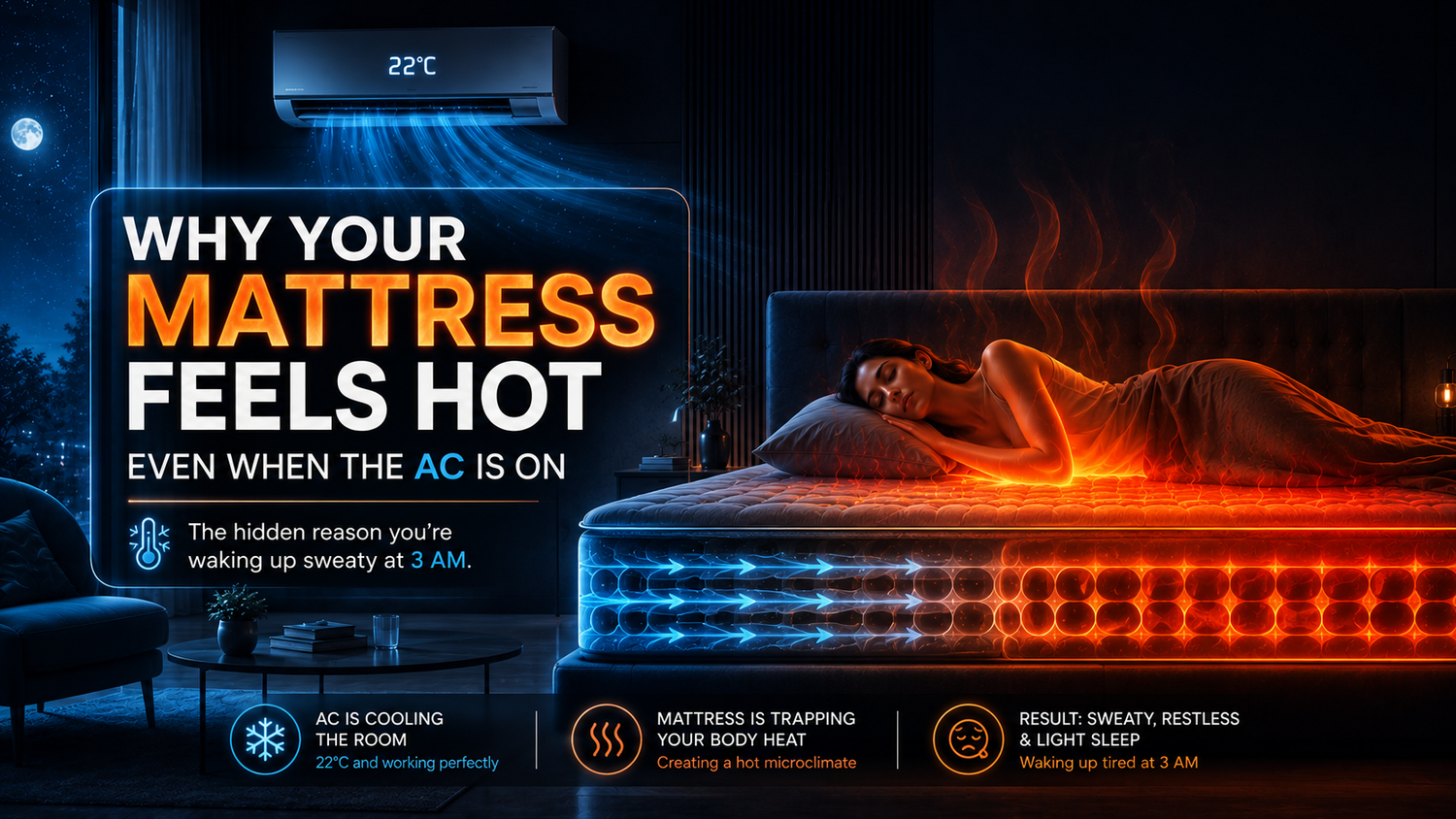
Why Your Mattress Feels Hot Even When the AC Is On
You've done everything right. The AC is set to 22°C. The fan is on. The room feels cool. And yet, an hour into sleep, you're kicking off the blanket, flipping your pillow to the cold side, and waking up in a layer of uncomfortable warmth that has nothing to do with the temperature in the room.
Sound familiar? You're not imagining it.
The uncomfortable truth is that your room temperature and your sleep surface temperature are two entirely different things — and for millions of Indians sleeping on the wrong mattress, the AC is fighting a battle it simply cannot win.
Here's exactly why that happens, and what the fix actually looks like.
The Real Reason Your Mattress Traps Heat
Most people assume sleeping hot is a body issue — "I just run warm." Sometimes that's true. But more often, the culprit is the mattress itself, and specifically, the materials it's made from.

Your Body Generates Significant Heat While You Sleep
Your core body temperature needs to drop by 1–2°C to initiate and maintain deep sleep. While that's happening, your body is actively radiating heat outward and that heat has to go somewhere. If your mattress materials absorb and hold that heat rather than dispersing it, the surface temperature climbs steadily through the night.
By 2–3 AM even in an air-conditioned room your sleep surface can be several degrees warmer than the surrounding air. That's when you start tossing, turning, and waking up.
The Problem With Conventional Foam Mattresses
This is where material science matters. Traditional foam especially dense memory foam is notorious for heat retention because of how it's structured:
- Closed-cell foam construction traps air pockets that absorb heat with nowhere to go
- High-density foam contours to your body closely, which feels good but reduces airflow between you and the mattress
- Synthetic surface fabrics polyester blends common in budget mattresses don't breathe, creating a sealed warm layer right where your skin makes contact
- Thick comfort layers increase insulation, worsening heat build-up the deeper into the night you go
The result? No matter how cold your room is, your body and the mattress create a microclimate of trapped warmth that your AC simply can't reach.
Why This Gets Worse in India
India's climate creates a uniquely challenging sleep environment and not just during summer:
- High ambient humidity (even with AC running) means sweat doesn't evaporate efficiently, making the hot sensation feel even more intense
- Concrete and brick construction in urban apartments absorbs heat during the day and slowly radiates it back through the night the room may feel cool at 10 PM but noticeably warmer at 3 AM
- Load-shedding and power fluctuations mean AC units frequently cycle off, leaving a heat-trapping mattress as the only variable between you and a sweaty, fragmented night
- Indian body types and sleep habits many Indians sleep on their back or stomach, positions that increase body-surface contact with the mattress and worsen heat build-up
This is precisely why a mattress built and tested for Indian conditions performs so differently from one designed for a cooler European or North American climate.
What a Sleep-Cool Mattress Actually Does Differently
The solution isn't a thinner mattress or simply buying a "cooling gel" topper and hoping for the best. Genuine temperature regulation in a mattress comes from three things working together: material structure, airflow design, and surface fabric.
Here's what to look for and why it matters:
1. Open-cell or channelled foam structure Unlike dense closed-cell foam, open-cell or cut-channel foam allows air to move through the mattress continuously. Heat dissipates rather than accumulating. This is an engineering decision, not a marketing claim you can feel the difference within the first hour of sleep.
2. Breathable surface fabric The top layer what your skin actually touches determines how much heat and moisture gets trapped at the surface. Engineered breathable yarns allow heat to escape and moisture to wick away, keeping the immediate sleep surface consistently cooler.
3. Natural or plant-based material treatments Some of the most effective heat-regulating properties come not from synthetic chemical sprays but from material choices that inherently work with your body's thermal regulation. This is an area where thoughtful material sourcing makes a real, lasting difference.
How Roma Puf Builds Around This Problem
At Roma Puf, heat retention isn't an afterthought - it's one of the central design problems our mattresses are engineered to solve, specifically for Indian sleepers.
The Roma Puf Pappy Flip Dual Comfort Mattress addresses the heat problem at every layer:
-
Aerowick™ 2D Foam - This is the core of the cooling system. The foam is precision-cut with continuous airflow channels that run through the entire comfort layer. Rather than trapping your body heat, these channels allow warm air to move away from your body and cooler air to take its place passively, all night long. No gel inserts, no chemical phase-change materials that lose effectiveness over time. Just smart foam engineering that works reliably for years.
-
Mel ion+™ Antibacterial Breathable Fabric - The outermost surface layer is made from an engineered antibacterial yarn that's specifically selected for breathability. It wicks away surface moisture, reduces the humidity microclimate your body creates while sleeping, and stays consistently cooler to the touch compared to standard polyester or synthetic-blend covers.
-
Tulsi Technology™ - Inspired by the natural properties of holy basil, this plant-based fabric treatment provides antibacterial and insect-repelling properties without synthetic chemical coatings. It keeps the fabric fresh in humid Indian conditions which matters because a mattress that stays cleaner also stays fresher-smelling and more comfortable through warmer months.
-
Dual comfort flip design - If you find yourself sleeping hotter in summer months, simply flip to the softer side, which has a lighter comfort layer and slightly more airflow.
The result is a mattress that works with your AC rather than against it your room does its job, and the mattress does its job. The two systems together create the consistent cool sleep surface that actually gives you deep, uninterrupted rest.
The Sustainable Angle: Why Material Choices Matter Long-Term
Synthetic cooling gels and chemical phase-change coatings are common quick-fixes in the mattress industry but they degrade. After 2–3 years, many of these treatments lose their effectiveness, and you're left with the same heat-trapping mattress underneath.
At Roma Puf, we take a different approach. Our manufacturing process uses water-based adhesives instead of solvent-based chemical bonding agents — better for the environment, and safer for you. We source materials chosen for inherent, lasting performance rather than short-lived surface treatments.
A Roma Puf mattress doesn't just sleep cool when it's new it's built to maintain that performance over years of use. Durable construction and quality material sourcing means less waste, fewer replacements, and a better long-term investment for you and for the planet.
Quick Fixes You Can Try Tonight
While upgrading your mattress is the most complete solution, a few immediate changes can help in the short term:
- Raise your AC's fan speed rather than dropping the temperature — better air circulation helps more than a colder thermostat
- Switch to 100% cotton or bamboo bedsheets synthetic fabric traps heat at the surface; natural fibres breathe significantly better
- Keep a bowl of ice or a cold pack near the bed evaporative cooling from a fan pointed at it can drop perceived temperature by 2-3°C
- Avoid eating heavy meals within 2 hours of sleep digestion raises core body temperature and worsens heat retention
- Keep the bedroom door slightly open if AC is in another room airflow matters as much as temperature.
These help. But if you're waking up hot consistently, none of them solve the root cause the mattress itself.
The Bottom Line
Your AC isn't failing you. Your mattress might be. Heat-trapping foam, synthetic fabrics, and poor airflow design create a warm microclimate that no thermostat can fully overcome. The fix is a mattress engineered to let heat out — not just one that feels comfortable in the showroom.


Leave a comment
This site is protected by hCaptcha and the hCaptcha Privacy Policy and Terms of Service apply.