
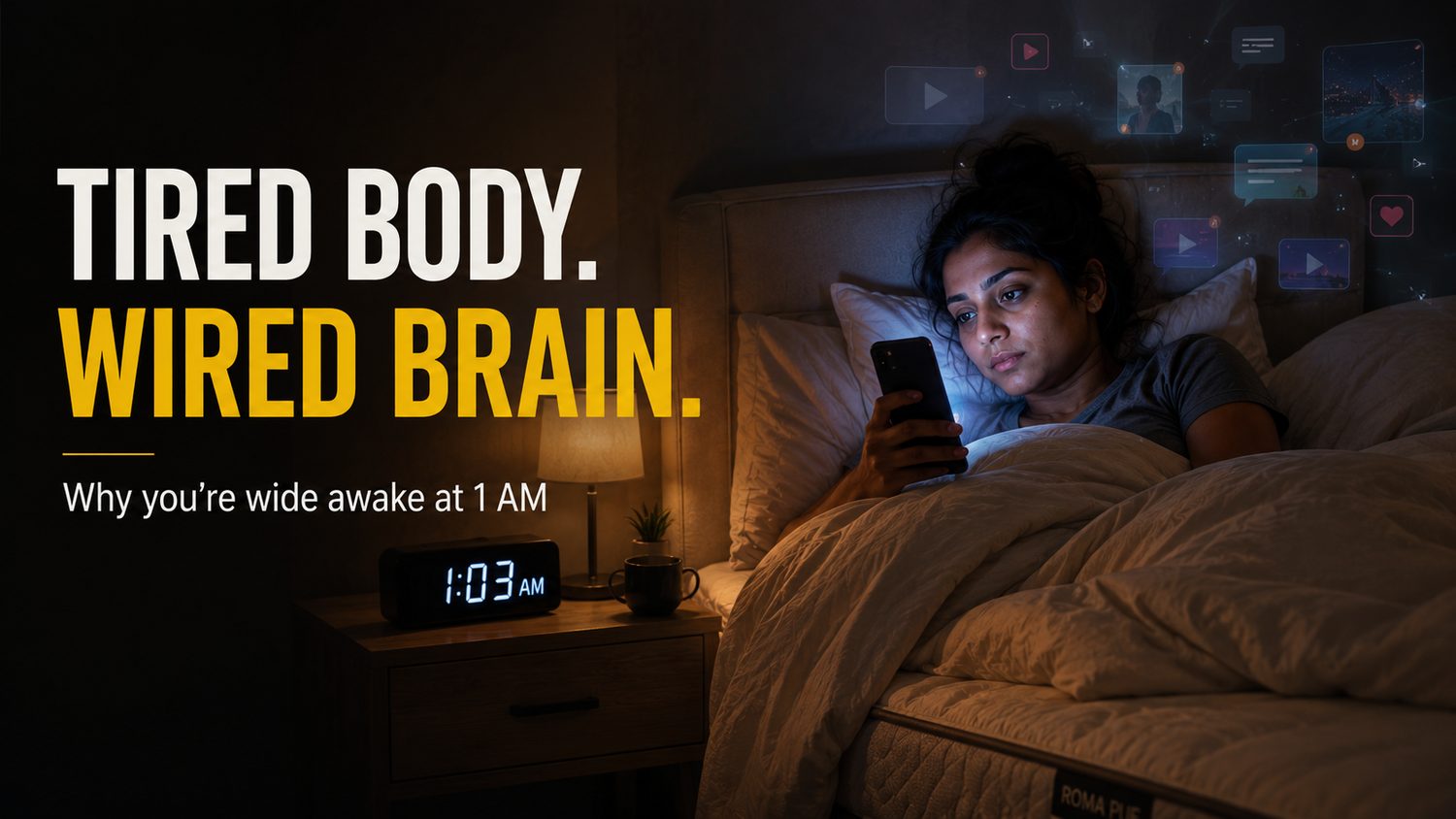
 It's 01:14 AM. You have a 9 AM standup. You are, by any reasonable measure, exhausted. And yet here you are, three reels deep, telling yourself "just five more minutes" for the fourth time in a row.
If this feels uncomfortably familiar, you're not lazy, and you're not undisciplined. You have a name for what you're doing now: revenge bedtime procrastination — and if you live in urban India, you're in very crowded company.
What Revenge Bedtime Procrastination Actually Is
The term started circulating among overworked office employees in China, who described staying up late purely to reclaim a sense of control over their own time — even knowing they'd pay for it the next morning. The "revenge" isn't against a person. It's against a day that never felt like it belonged to you.
Psychologists describe it as a quiet form of rebellion. When work spills into your evenings, when your commute eats your mornings, and when your "free" hours are really just leftover hours, staying up late becomes the only way to claim something back. Dr. Ashwini NV, a psychologist who has written about the trend, calls it exactly that: a psychological rebellion that shows up when people feel their day was never truly theirs.
The uncomfortable part is that this isn't a fringe habit. A survey by the psychology department at Saurashtra University found that roughly 65% of over 1,300 participants showed some degree of revenge bedtime procrastination. Separately, researchers have flagged that 61% of Indian adults report poor sleep quality overall — a number that's hard to look at without connecting the dots.
Why Urban India Is Especially Prone to It
A few things are colliding at once, and none of them are your fault:
- Long, blurry workdays. Analyses of Indian industrial and office work patterns put average working hours well above the global norm, often close to 10–12 hours once commute and after-hours messages are counted in. When the workday doesn't end, "me-time" gets pushed later and later.
- Notifications that never sleep. A late-night scroll rarely starts as a decision — it starts as one more check of the phone that turns into forty-five minutes you didn't plan on losing.
- A culture that still treats rest as optional. Sleep is often the first thing sacrificed when a day runs long, precisely because it's the only thing that doesn't complain immediately.
The result is a slow, quiet erosion. Chronic short sleep has been linked to weaker immunity, foggier decision-making, and higher long-term risk for issues like heart disease and diabetes — and worse decision-making the next day makes you more likely to reach for the same late-night "me-time" fix again. It's a loop, not a one-off bad night.
The Sneaky Bit: You Can't Always Tell It Apart From Insomnia
One detail from recent reporting on the trend is worth sitting with: revenge bedtime procrastination can look almost identical to genuine insomnia from the outside, and sometimes even from the inside. Both leave you tired and awake at an hour you didn't intend. The difference is that one is driven by a body that won't switch off, and the other is driven by a mind that refuses to let the day end without a little time that felt like yours. Knowing which one you're dealing with matters, because the fixes are different — and for a lot of people, it's more of the second than the first.
How to Reclaim Your Evenings Without Losing Sleep
The good news buried in all this research: the fix isn't "just go to bed earlier." It's giving your day back some of what it took from you, so your body doesn't feel like it has to steal it at midnight.
- Carve out real downtime during the day, not just at night. Even 15–20 minutes of a lunch break spent on something that's purely yours — a walk, music, a chapter of a book — reduces the pressure to overcompensate at 11 PM.
- Set a "device sundown" 30 minutes before bed. This is one of the most consistently recommended counter-strategies, and it works less because of blue light and more because it removes the bottomless-scroll trap.
- Give your wind-down an actual cue. A fixed alarm that says "this is when the evening starts winding down" does more than willpower ever will, because it removes the moment-to-moment decision to stop.
- Make your bed a place you actually want to be. This one gets overlooked constantly. If getting into bed means fighting a mattress that's gone lumpy, sleeping hot under a blanket, or waking up with a stiff neck, some part of you will keep finding reasons to stay on the couch a little longer. A bed that's genuinely comfortable — supportive where you need it, cool enough for an Indian night, quiet when your partner shifts — removes one more excuse to delay.
- Protect the transition, not just the bedtime. Reading a physical book for even ten minutes, or simply lying down in the dark without a screen, gives your nervous system the runway it needs to actually downshift.
None of this asks you to stop wanting time for yourself — that instinct is healthy. It just asks you to stop taking that time from the one system in your body that has no other way to fight back.
Why the Bed Itself Is Part of the Fix
We build mattresses at Roma Puf, so we'll be upfront about where our bias sits — but the reasoning holds regardless of what you sleep on: a bed you actually look forward to getting into is a genuinely underrated tool against revenge bedtime procrastination. It's much easier to end a scroll session when the alternative is inviting rather than something to tolerate.
If heat, motion transfer, or a mattress that's stopped supporting your back are part of why you keep finding reasons to stay up, that's worth solving on its own terms — not through more willpower, but through a setup that actually holds up its end. Our orthopedic and memory foam mattresses are built with breathable, antimicrobial covers and pressure-relieving support designed for Indian nights, and if neck discomfort is part of what keeps you reaching for your phone instead of your pillow, our cervical support pillows are worth a look too. Every Roma Puf mattress ships with a 100-night trial, so there's no pressure to decide on day one — you get to actually test whether a better bed changes your nights.
Curious what actually goes into that support? We've written openly about it in what actually goes inside a Roma Puf mattress, and about our approach more broadly on our story page.
The Bottom Line
Revenge bedtime procrastination isn't a discipline problem — it's a signal that your day isn't giving you back enough of what it takes. The most effective fix isn't a stricter bedtime rule; it's making the handoff from "your time" to "sleep time" as painless as possible, starting with a bed that doesn't feel like one more thing to push through.
Tonight, try this: put the phone down when the alarm says to, not when you finally run out of things to scroll. Your 9 AM self will thank your 11 PM self — and so, eventually, will the rest of you.



Leave a comment
This site is protected by hCaptcha and the hCaptcha Privacy Policy and Terms of Service apply.