
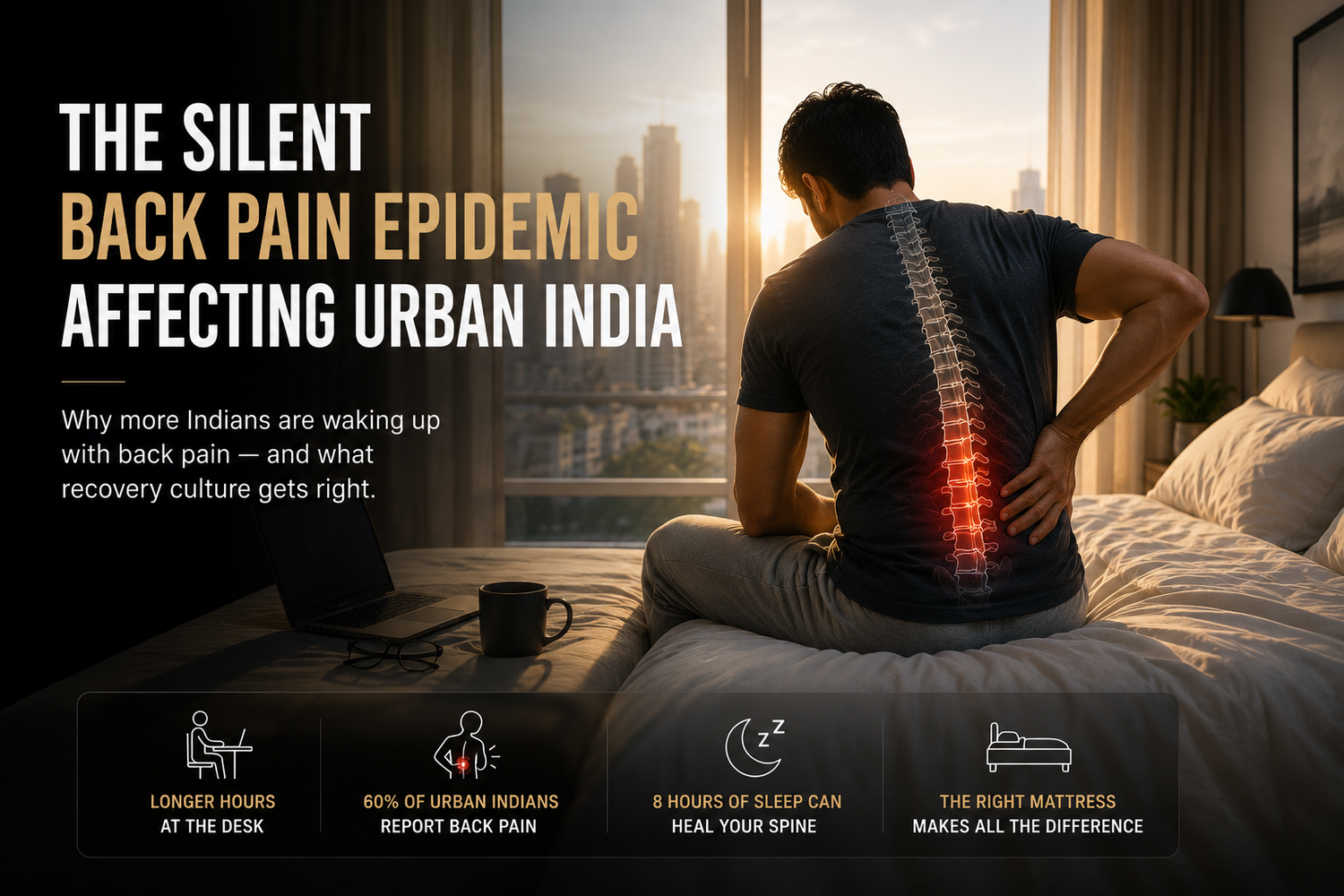
The Silent Back Pain Epidemic Affecting Urban India
If you've ever stood up from your work-from-home desk, felt your lower back seize for a second, and thought "this can't be normal" — you're not alone. You're one of roughly 60% of urban Indians dealing with the same thing.
For the last decade, Indian work culture worshipped hustle. Longer hours, less sleep, more grinding. But 2026 is turning out to be the year that mindset quietly cracks. A new "recovery culture" is taking over — and for once, sleep experts, doctors, and mattress makers actually agree on something: the fix isn't another productivity hack. It's fixing what happens after you clock off, starting with the eight hours your spine spends horizontal.

The Real Reason Your Back Hurts Isn't Just Posture
Ask most people why their back hurts and they'll blame their office chair or their phone-scrolling posture. Both play a part. But there's a quieter culprit that rarely comes up: what you're sleeping on.
Desk-bound days already compress and misalign the spine. If your mattress doesn't actively support that realignment overnight, your body never gets the one real chance it has to recover before the cycle repeats the next day. Over months, that adds up to chronic tightness, stiffness, and the kind of dull ache that painkillers only mute, never fix.
The "Rock Hard = Good for Your Back" Myth Is Finally Dying
For a long time, Indian households operated on an unspoken rule: back pain means you need a harder mattress. It's practically inherited wisdom — passed down like a home remedy.
Here's the problem: it's outdated. A too-firm mattress doesn't cushion your hips and shoulders, which forces your spine out of its natural alignment, especially if you sleep on your side. The more accurate way to think about it isn't "hard vs. soft" — it's aligned vs. misaligned. What your back actually needs is contouring support: firm enough under the lower back to prevent sinking, soft enough at the shoulders and hips to avoid pressure points.
This is exactly the gap orthopedic-support mattresses are built to close — not by being harder, but by being smarter about where support is distributed.

What "Recovery Culture" Actually Looks Like in Practice
Recovery culture isn't a wellness trend confined to foam rollers and ice baths. For most urban Indians, it's showing up in three quieter, more consistent habits:
- Treating sleep as non-negotiable, not the thing you sacrifice first when deadlines pile up
- Choosing tools that support the body, not just willpower — ergonomic chairs, standing desks, and yes, mattresses built for spinal support
- A "golden hour" before bed — winding down screen time to actually let the body downshift before sleep, rather than crashing straight from a lit-up phone screen into bed
None of this requires overhauling your life. It requires treating recovery with the same seriousness you already give your workday.
What to Actually Look for If Back Pain Is Your Main Concern
If you're mattress shopping with back pain specifically in mind, a few things matter more than brand names or marketing claims:
-
Zone-specific support — not uniform firmness throughout, but graduated support that adjusts to your lower back, hips, and shoulders differently
-
Pressure relief material — high-resilience or memory foam that responds to your body rather than pushing back uniformly
-
Motion isolation — especially relevant if you share the bed; you shouldn't feel every shift your partner makes
-
A trial period — because no showroom test can replicate weeks of actual sleep, and your back will tell you the truth faster than any salesperson can
This is where Roma Puf's orthopedic-focused range was built with intention rather than as an afterthought. Our Eternal Orthopedic line uses graduated support zones designed around exactly this kind of lower-back demand, and every mattress ships with a 100-night trial — long enough for your body to actually tell you whether it's working, not just whether it feels nice on day one.
A Simple Bedroom Recovery Checklist
If you want to start treating your sleep setup with the same seriousness as your workday, here's a starting point:
- Check if your current mattress is more than 7–8 years old (foam support breaks down over time, even if it looks fine)
- Notice if you wake up with stiffness that improves within the first hour of moving around — that's often a support issue, not a medical one
- Look for contouring, zone-based support rather than uniform firmness
- Give any new mattress a real trial period before deciding
- Pair better sleep surfaces with basic sleep hygiene — consistent sleep times, less light exposure before bed
The Bottom Line
Back pain in urban India isn't a mystery — it's the predictable result of long desk hours meeting mattresses that were never built to counteract them. The shift toward recovery culture isn't about doing more; it's about finally giving your body the support it needs during the one part of the day you're not actively working against it.
Your back does its healing at night. It might be worth checking whether what you're sleeping on is actually helping — or quietly working against you.
Explore Roma Puf's Eternal Orthopedic range — designed for graduated back support, backed by a 100-night trial. Curious how mattress heat affects your sleep too? Read our related post on Why Delhi's Air Pollution May Be Following You into the Bedroom

Leave a comment
This site is protected by hCaptcha and the hCaptcha Privacy Policy and Terms of Service apply.