
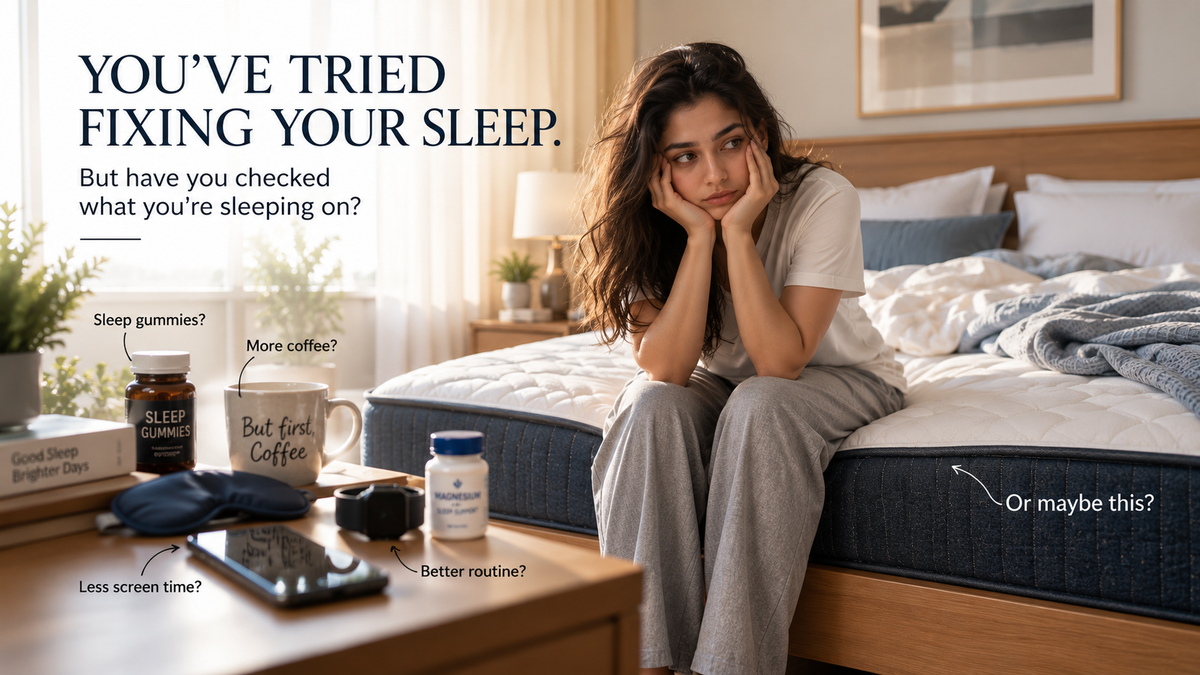
Why Your Mattress Might Be the Real Reason You're Not Sleeping Well
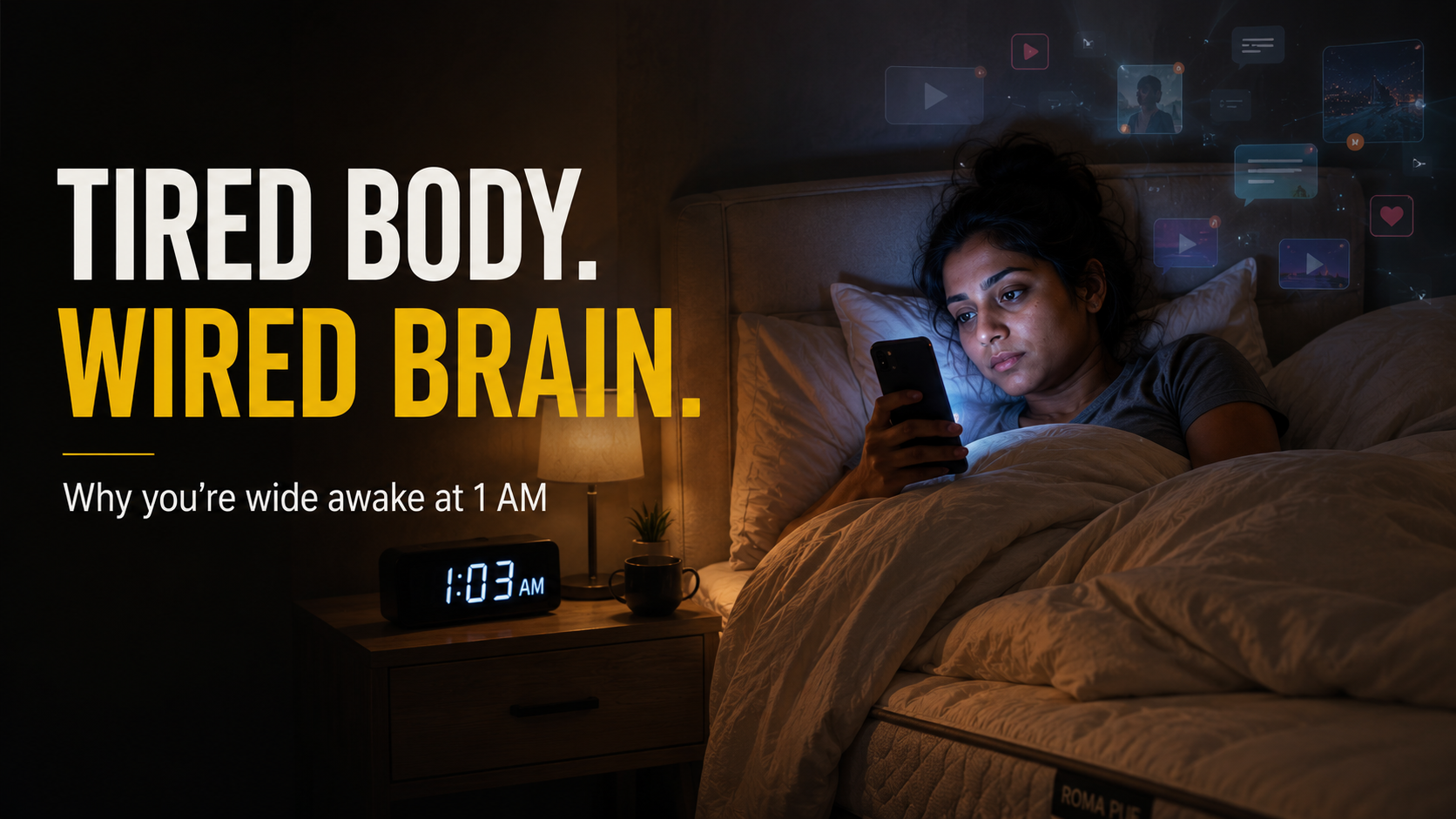
If you've been waking up groggy, reaching for a sleep gummy, or scrolling "how to sleep 8 hours in 4" at 1 a.m., you're not alone. Recent research shows nearly 60% of Indians sleep less than six hours a night, and online search interest in sleep supplements has spiked more than 600% over the past year. Melatonin, magnesium, and ashwagandha gummies have quietly become a mainstream part of the Indian wellness cabinet — with even celebrity-backed brands normalizing "sleep optimization" as something you shop for, not just something that happens to you.
But here's the question almost nobody stops to ask: what are you actually sleeping on? A pill can help you fall asleep faster. It can't undo eight hours a night on a mattress that's fighting your spine.
India's Quiet Sleep Debt Problem
The numbers paint a fairly stark picture. Beyond the six-hours-or-less statistic, separate research estimates well over 100 million Indian adults live with some degree of obstructive sleep apnoea, and a large share of urban professionals report their sleep has gotten worse, not better, in recent years — driven by longer screen time, later work hours, and general lifestyle stress. India's sleep-aid and wellness market has grown into a genuinely large industry as a result, with dozens of new supplement and sleep-tech brands entering the space in the last two years alone.
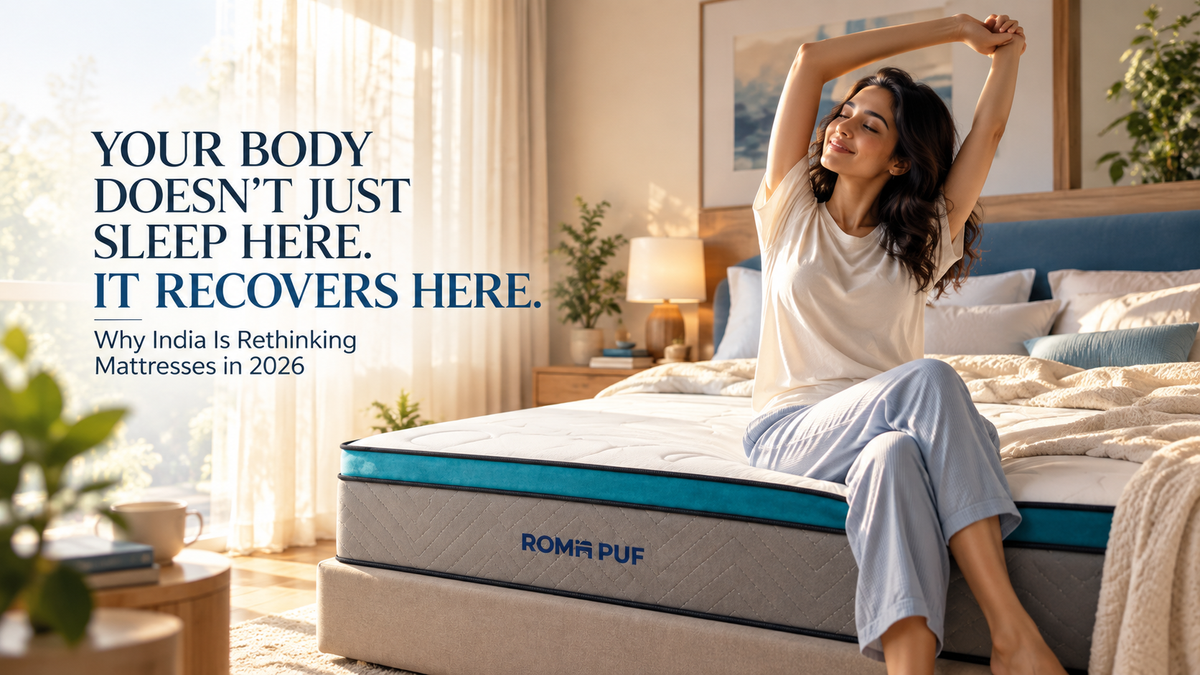
What's interesting is where the conversation is heading next. Industry watchers are increasingly describing 2026 as a "recovery culture" year for sleep — the shift from treating rest as a problem to medicate away, toward treating it as a system you actively build. And a growing number of consumers are realizing that system starts with the surface underneath them, not the bottle on the nightstand.
Orthopedic Support Is No Longer a Niche Concern
One statistic keeps showing up across recent consumer research: close to 60% of urban Indians report ongoing lower back issues. Physiotherapists and orthopedists are increasingly naming the same overlooked culprit — mattresses that are either too firm (the old "hard mattresses are good for your back" myth many of us grew up with) or too soft to keep the spine in a neutral line through the night.
The result is a real shift in what people look for when they shop. Instead of asking "how firm is it," more buyers are asking "does it support where I need support and give where I need give." That's a meaningfully different question, and it's changing what a "good" mattress actually looks like in 2026.
Personalization Is Becoming the Default
Alongside the orthopedic angle, there's a broader move toward personalization in how Indians choose mattresses. Rather than a single firmness sold to every body type, shoppers increasingly expect some way to match a mattress to their own weight, sleep position, or the fact that they share a bed with someone whose needs are completely different from their own — a common scenario for couples with a noticeable weight difference, a back-sleeper paired with a side-sleeper, or simply two people who've never agreed on "medium-firm" meaning the same thing. Some premium mattress brands are now leaning on biometric data and body-scanning tools to make this kind of recommendation, treating firmness the way a running shoe brand treats foot type — as something worth measuring rather than guessing at in a showroom.
That same instinct — support shouldn't be one-size-fits-all — is exactly why flippable, dual-comfort designs are gaining traction even without the biometric tech. If you can physically choose your firmness and change your mind later, you've solved a big part of the personalization problem without needing an app or a body scan to do it.
Signs It Might Be the Mattress, Not Just Your Habits
It's easy to blame late nights, phone scrolling, or stress for restless sleep — and those matter. But there are a few tells that point specifically to the mattress itself: waking up with a stiff lower back that eases within the first hour of moving around, feeling noticeably hotter in bed than the room temperature would suggest, sinking into a permanent dip on your side of the bed, or lying awake very aware of your partner's every movement because the surface transfers motion instead of absorbing it. If any of that sounds familiar, no amount of magnesium before bed is going to fully solve it — the fix has to happen at the mattress level, not just the bedtime-routine level.
What This Looks Like in an Actual Mattress
A few concrete shifts are showing up consistently in what sleep-conscious Indian buyers are asking about right now.
Dual or zoned firmness support. Rather than committing to one firmness level for years, more buyers want a mattress that offers a genuine choice. This is the idea behind our Pappy Flip Dual Comfort Mattress — it's flippable between two distinct firmness sides, so you (or your partner) aren't locked into a single feel you might grow to dislike, whether your needs change or you simply want to test what actually works for your back.
Climate-adaptive cooling. Dense memory foam and Indian summers don't mix well — heat gets trapped rather than released, which is a big part of why people wake up sweating and restless. The trend is toward breathable, open-cell constructions that let air move through instead of pooling. Our Aerowick 2D cooling layer is built specifically around this, designed to keep airflow moving through the core of the mattress so warm nights don't undo a good night's sleep.
Hygiene as part of the sleep conversation, not an afterthought. As more people treat sleep as active wellness rather than passive downtime, the cleanliness of the surface itself is getting more attention — dust mites, moisture, and bacteria buildup aren't just an allergy-sufferer's concern anymore. That's the reasoning behind our Mel ion+ antibacterial fabric layer, which works to keep the sleep surface fresher between washes.
A nod to natural, familiar ingredients. The same shoppers stocking up on ashwagandha and chamomile are also gravitating toward mattresses that build in natural, calming elements rather than relying purely on synthetic foams. It's part of why we work Tulsi Technology into select layers — bringing a genuinely familiar, grounding ingredient into an unexpected place.
Supplements Won't Fix a Mattress-Shaped Problem
None of this is an argument against a good wind-down routine, magnesium, or a calming cup of tea before bed — plenty of people genuinely benefit from all three. But the data is fairly clear that a large share of India's sleep problem is structural and physical, not purely chemical. Propping up bad sleep with caffeine and supplements while lying on a mattress that's actively working against your spine is treating the symptom while leaving the actual cause untouched.

Worth Testing Before You Commit
Judging a mattress from a showroom visit or a product photo is genuinely difficult — you're guessing how your body will respond after three weeks of actual sleep, not the first ten minutes lying down. That's really the reasoning behind offering a 100-night trial: enough time to notice whether your back pain actually eases, whether you're waking up cooler through the night, and whether you find yourself reaching for the sleep gummies a little less often.
If 2026's sleep story really is about treating rest as something you actively build rather than something you hope happens to you, the mattress underneath you is a genuinely reasonable place to start.

Leave a comment
This site is protected by hCaptcha and the hCaptcha Privacy Policy and Terms of Service apply.